
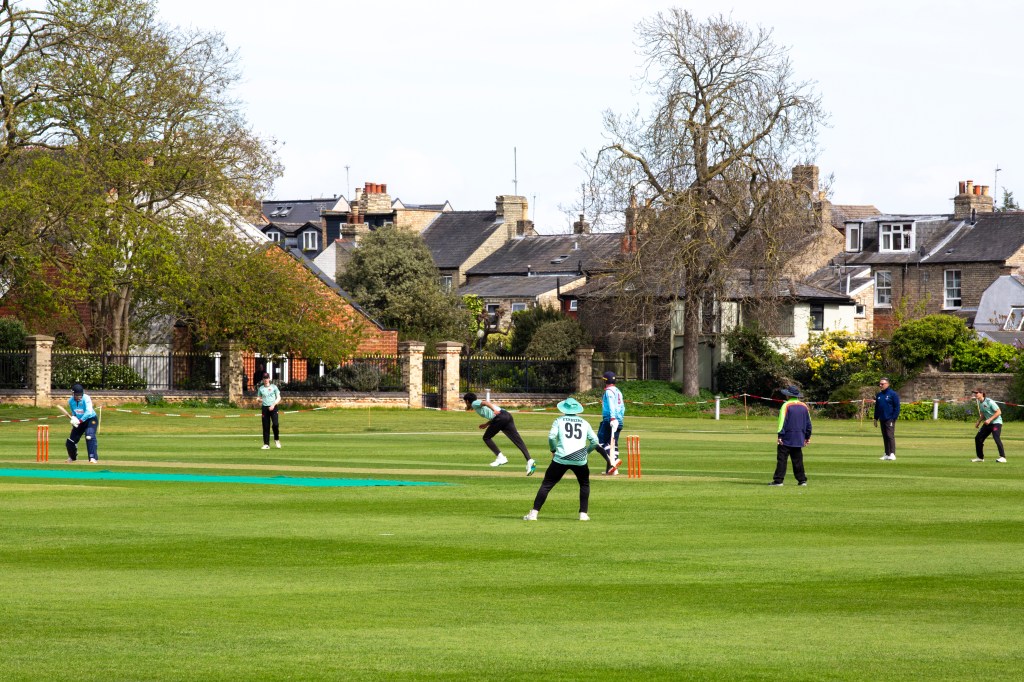
Not bowled over: Hughes Hall’s latest development plans to build at Fenner’s fail to present a convincing case.
Alex Wall, local resident
“We appreciate Hughes Hall providing more details of their plans. However regarding Site 3 in particular, there have been no revisions to Hughes Hall’s drawings as a result of residents’ feedback.
The model for the new Wileman Court building, Site 3, shows a much bigger footprint than the current Pavilion building and it will encroach on Fenner’s Protected Open Space as a result. With three storeys proposed, where currently there is a one-storey building, I am hugely concerned it will appear very dominant and give an overbearing sense of enclosure.”
Lucy Walker, former city councillor and local resident
“I am already upset that Hughes Hall has managed to enclose Fenner’s from public access, so that it is essentially reduced to a college amenity.
And now it is hard to believe that the college, which hosts the Centre for Climate Engagement, is persisting with plans to build on one of Cambridge’s vital green “lungs”. Fenner’s has a high protection rating for its environmental value to the whole city.
Any breach of POS opens the way for further development anywhere in the city, and it is unacceptable if the principle of protecting our valuable green spaces is overturned, when the college has other choices it could make.”
Professor Martin Jones, Cambridge University and local resident
“Hughes Hall has now adapted part of its plans to be more in line with University and City policies, which is to be welcomed. But I find it completely baffling that the college still intends to spill out over land designated as Protected Open Space. If this is allowed to be undermined in any way by Hughes Hall at a time of intensive growth, then the future of Cambridge’s central green spaces doesn’t bear thinking about.
The primary educational contribution of Cambridge colleges is the supervision of undergraduates in small groups. Hughes Hall can surely achieve its own contribution in that context without encroaching upon Protected Open Space.”
Michael Blackburn, local resident
“Rather than scaling back its original plans, we now know Hughes Hall is increasing from 100 to around 120 the number of student rooms it intends to build in five storey blocks and a three storey building. Whichever way the college presents the figures, the fact remains that a significant amount of green protected land will be lost to an oppressive development at Fenner’s.”
James McNiven, local resident
“Planning privileges that could enable Hughes Hall to build on Protected Open Space seem to further a Town vs Gown mentality that is out of step with an integrated and progressive city. If a commercial business tried to do this, it wouldn’t be allowed.
I am very disappointed to hear that Protected Open Space continues to be a target for development by Hughes Hall.
While there is a stated willingness to work with the local community, it is ultimately the permanent residents of Cambridge that will suffer from the removal of green space if this development is allowed.”
Simon Callaghan, former player for Cambridge University Cricket Club
“Fenner’s is a hallowed place for cricket fans the world over and it is very important that it remains an integral part of Cambridge’s identity as the original blue. This beautiful ground with its rich history and unique character should not be compromised by Hughes Hall for the sake of some more study spaces or further dorms.
We must make sure the proposed developments do not happen. Open space is critical to both the city’s and the university’s culture and well-being.”
Professor Ian Bent, Life member of Cambridge University Cricket Club, and local resident
“Hughes Hall’s claim that it is “safeguarding … sport at Fenner’s for future generations” doesn’t match the facts. The college made us the same promises in 2000 and in 2014 when applying to construct two other buildings, and since then the public has lost open access and the condition and management of the pitch have deteriorated inexorably.”
Dr Stephen Platt, Director of Cambridge Architectural Research, Member of Cambridgeshire Quality Panel, and Cambridge University Cricket Club member
“Green spaces like Fenner’s are vital for climate resilience and well-being. This is especially true in a city like Cambridge, which is growing rapidly and under intense development pressure.
No matter how little Protected Open Space (POS) is taken for development, a precedent will be set and planning protection undermined.
The city’s Protected Open Space planning policy is therefore vitally important. I believe it should be strengthened by removing clauses 2 and 3, which make POS vulnerable by simply requiring replacement of open space to be provided at an alternative location or where it meets the vaguely worded demonstrable educational need.”
In conclusion, Lionel Sheffield, chair Protect Fenner’s Action Group
“Hughes Hall has recently revised its’ plans after our dedicated campaign. Most of the new accommodation is now to be built on a brownfield site, away from the cricket field. That is the good news; the bad news is that nearly 600 sq.m of the Fenner’s Protected Open Space is still at risk. In recent years, too much of the land around the cricket ground has been lost to unsuitable development and we will fight hard to ensure that no more land at this historic ground is given over to development, and especially one that is better suited elsewhere.
Additionally, the Protect Fenner’s Action Group is working hard to stop the imposition of the new Wileman Court development at Fenner’s because of the dominating and overbearing impact it will also have on the local historic houses of adjoining Covent Garden.”
Read the Action Group Statement HERE

